Ada Ruszkiewicz*
Ever since its opening in September 2025, Dance House in Valmiera has been offering glimpses into the Latvian contemporary dance scene through curated weekend programs, happening monthly. The most recent one took place on March 14 and 15, inaugurating the 2026 season, after a winter break. It featured four performances, including one premiere1.
The weekend opened with Vladimirs Goršantovs’ solo “I am Latvia too” (“Es arī esmu Latvija”), a personally engaged call out and critique of the homophobic discourse in Latvian politics, reflecting broader societal attitudes and prejudices. It was followed by Marija Saveiko’s “Neither of” (“Savējā un svešā”) – a duo for a dancer (Saveiko) and a guitarist (Kārlis Matīss Zitmanis), dealing with questions of (national) identity and the duality of belonging. Sunday’s program began with a premiere of “Fragile power” (“Trauslais spēks”). The performance, made up of five dancers and choreographed by Lelde Feldmane, is dedicated to caretaking and caregiving. It derives from Feldmane’s experience of co-caring for her grandmother. The program concluded with “With Eyes Closed” (“Ar acīm ciet”), co-choreographed by Elīna Gaitjukeviča and Dmitrijs Gaitjukevičs in collaboration with the dance group ‘Ritms’, in which eight dancers use movement as a medium to express the fears that shape and accompany the experience of adolescence.
Presenting the four performances together recontextualizes them. It both allows them to reach new audiences and enter a dialogue with one another – their resemblancesand differences offer a chance to designate new paths of attention and interpretation. Searching for what is common often involves generalizations. Keeping this in mind, it could be said that what the four performances share is a point of departure defined by positioning oneself in relation to others. In each of them, the personal experience becomes like a lens through which questions of social importance are looked at. The performances, therefore, could be seen as representations of emotional landscapes built around the chosen topics, in which movement translates emotions into stories that follow linear logic. This logic affects the structure of a performance, even if its presence and importance vary from scene to scene. The focus on the narrative is supported by the visual layer (including lights, costumes, props, etc.) built out of decodable symbols, as well as by the sound and music reinforcing the emotionality.
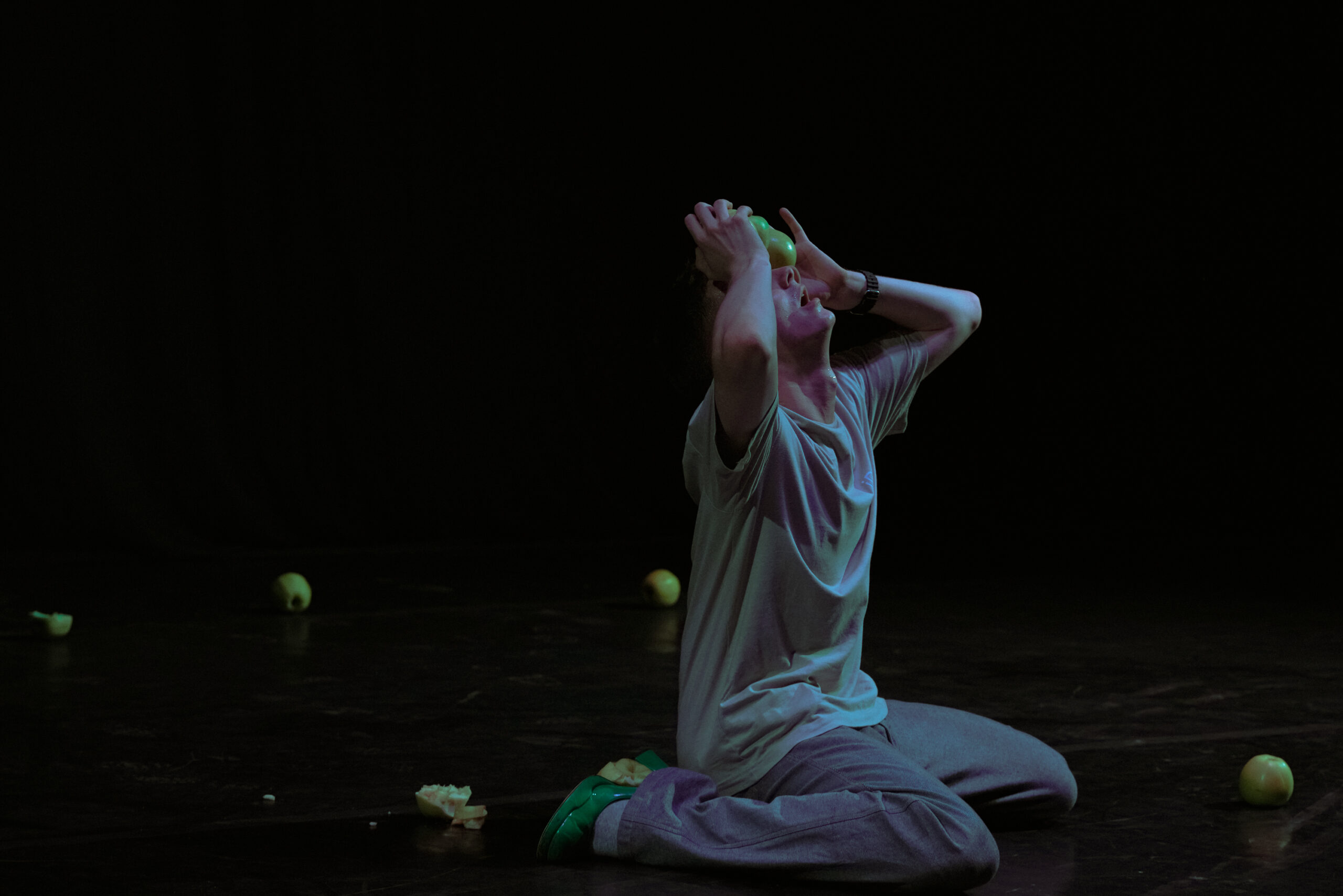
“I am Latvia too” offers a different, less traditional approach. One of the strongest elements of the performance is the decision to replace music with the compilation of fragments of speeches by members of the Latvian Parliament (composed by Edvards Kurmiņš). By freeing sound from its usual shape and function, new possibilities of engagement (both for the performer and for the audience) offer a chance to be born. The recordings can serve as a key to interpret the movement, while the movement (or lack of it) can affect what is heard and how it is heard. This dynamic is rarely made possible when the music is chosen for its tone and rhythm. Since the choreography can no longer follow the music, alternative points of reference are needed. The movement is therefore built around specific objects – apples, which are strewn on the stage forming the set design (designed by Andris Kaļiņins). The initial gesture of taking an apple out of the pocket continues with carrying, balancing, stepping on, laying on, crashing, licking, eating, throwing, smearing, and smashing it, along with all the other apples. The choreography balances between a formalistic approach, emphasizing the structure, technique, and physical form of movement over narrative, exploring the possibilities and challenges that the interaction with the object brings, and meaning-making, referring to what the apple could symbolize.
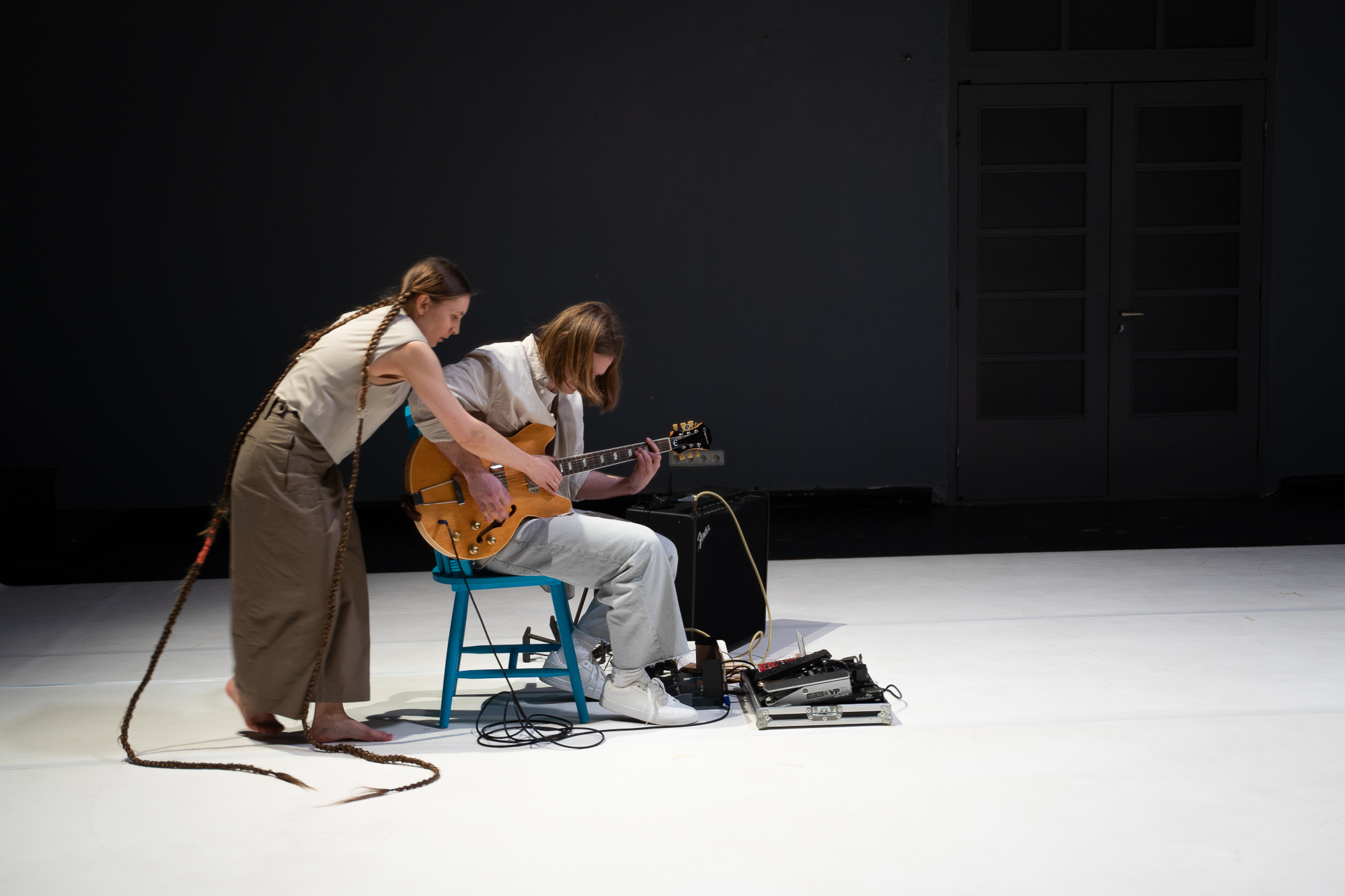
A similar, object-oriented focus characterizes “Neither of”. The main element of its minimalistic scenography (created by Kaiva Kumerova) is a set of small, white stairs. The stairs organize the movement in one of the first scenes, and keep returning afterwards – not only as an object to climb on but as something to lift, to carry, to hide behind, and to lie under. However, the principal choreographic premise is even simpler. While remaining in a close relationship with the sound, it derives directly from the title. The movement embodies the idea of (not) belonging, (not) fitting in – from balancing on the stairs, through a game-like attempt to dance within the bounds of an ever-shifting pattern of lit squares, to a search for a seat among the audience. Introducing interactivity often comes with a risk of it becoming a “party trick” – a way to entertain or provoke (or both), just for the sake of doing so. In “Neither of” this gamble or even more of a risk is successfully avoided. The engagement with the audience allows the performance to go beyond the illustrative and introduce a new quality into it; the question of belonging stops being a theoretical matter and turns into a physical experience. I was surprised by the tension that rose through my body as all the lights were turned on, and when the performer left the stage (extended the stage), looking for a seat to take. It was not a fear of potential interaction, rather resistance towards a new, unfamiliar setting, in which the performer stops dancing (but does not stop performing), abandoning her “assigned role”. This discomfort revealed to me internalized concepts of belonging and offered me access to the performance on a different, more embodied level.
Acknowledgment of the audience’s presence can take many different forms and does not necessitate direct engagement. The seemingly simple act of looking at the audience can already reveal its “hidden” presence and question the safe, passive position of those who consume. Through this, the traditional roles and responsibilities are challenged, at least on a symbolic level. It is interesting and quite telling that not only in “Neither of” but in all the presented performances, there is at least one scene of intentional eye contact, even though its function and importance might vary. For example, “I am Latvia too” starts with Vladimirs Goršantovs standing still and calmly looking at the audience members, one by one, as if establishing the temporary connection needed for continuing with the movement.
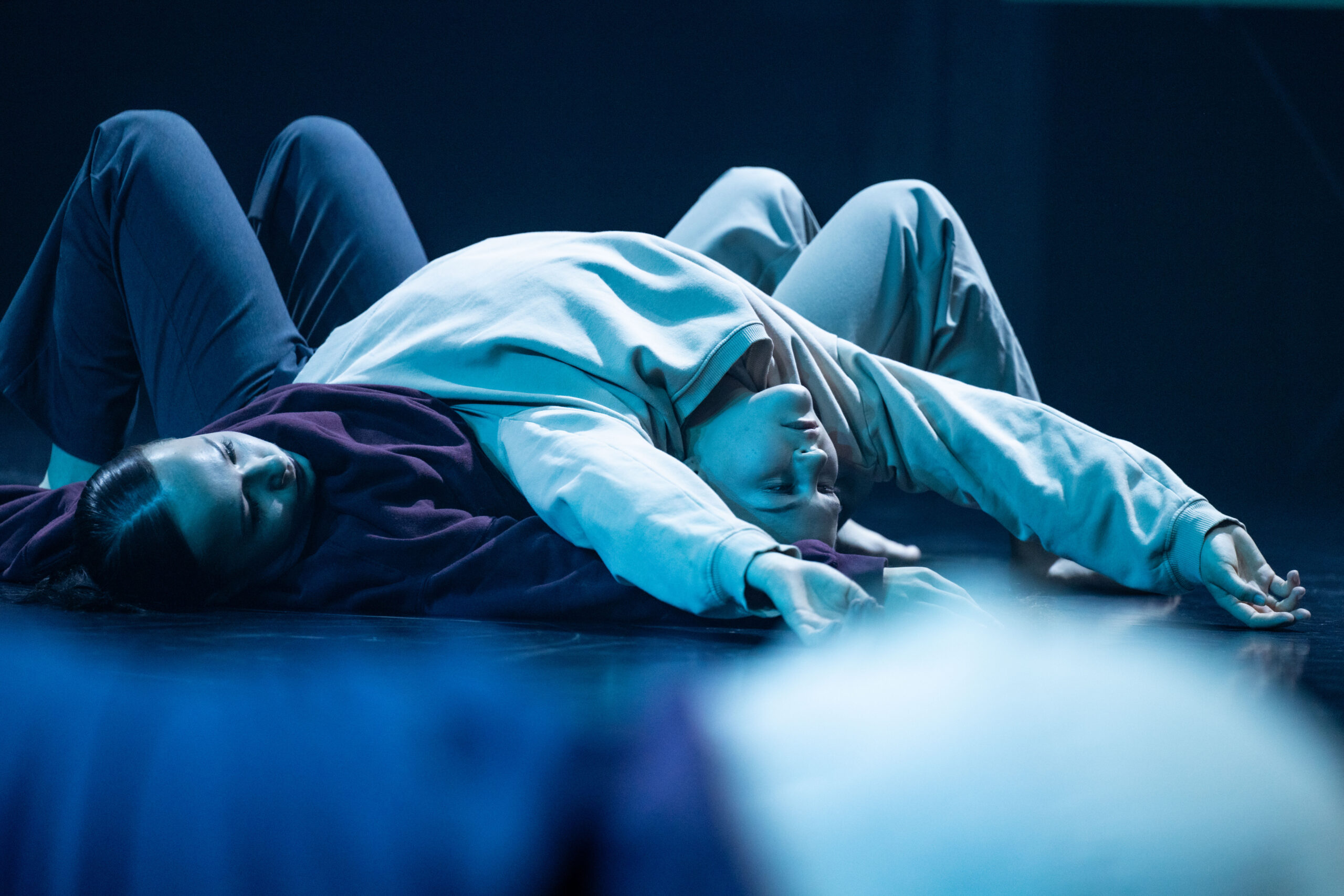
In “With eyes closed” eye contact is introduced only towards the end of the performance. For most of its duration, the performance explores various tropes of group choreography. In some moments, dancers interact directly, in others connect through synchronicity or intentional asynchrony. Their individuality, although not completely erased, seems, in a way, dissolved. Gradually, the quality of their movement starts to differ; a group dance morphs into a series of simultaneous solos. Upon reentering the stage, and just before her solo starts, one of the dancers takes a moment to look at the audience. After a short while, the second dancer does the same. For me, this confident, almost provoking look was saying “now it’s my moment, so I’m making sure that you’re looking” (or maybe “I know you’re looking, so now I’m goin’ to dance for you”?) and reinforced the individuating character of the scene. Keeping in mind the thematic scope of the performance, this could also read as a moment of overcoming fear, finding strength, and independence within the movement.
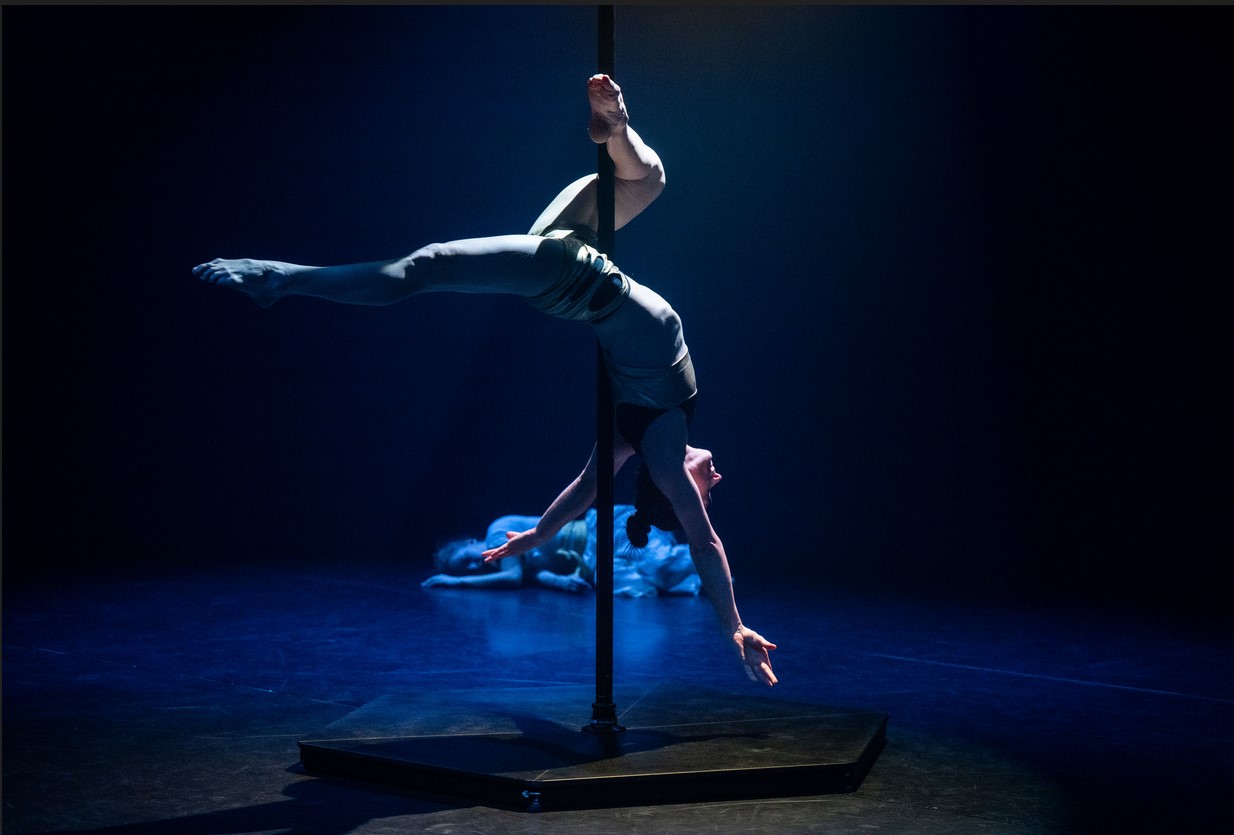
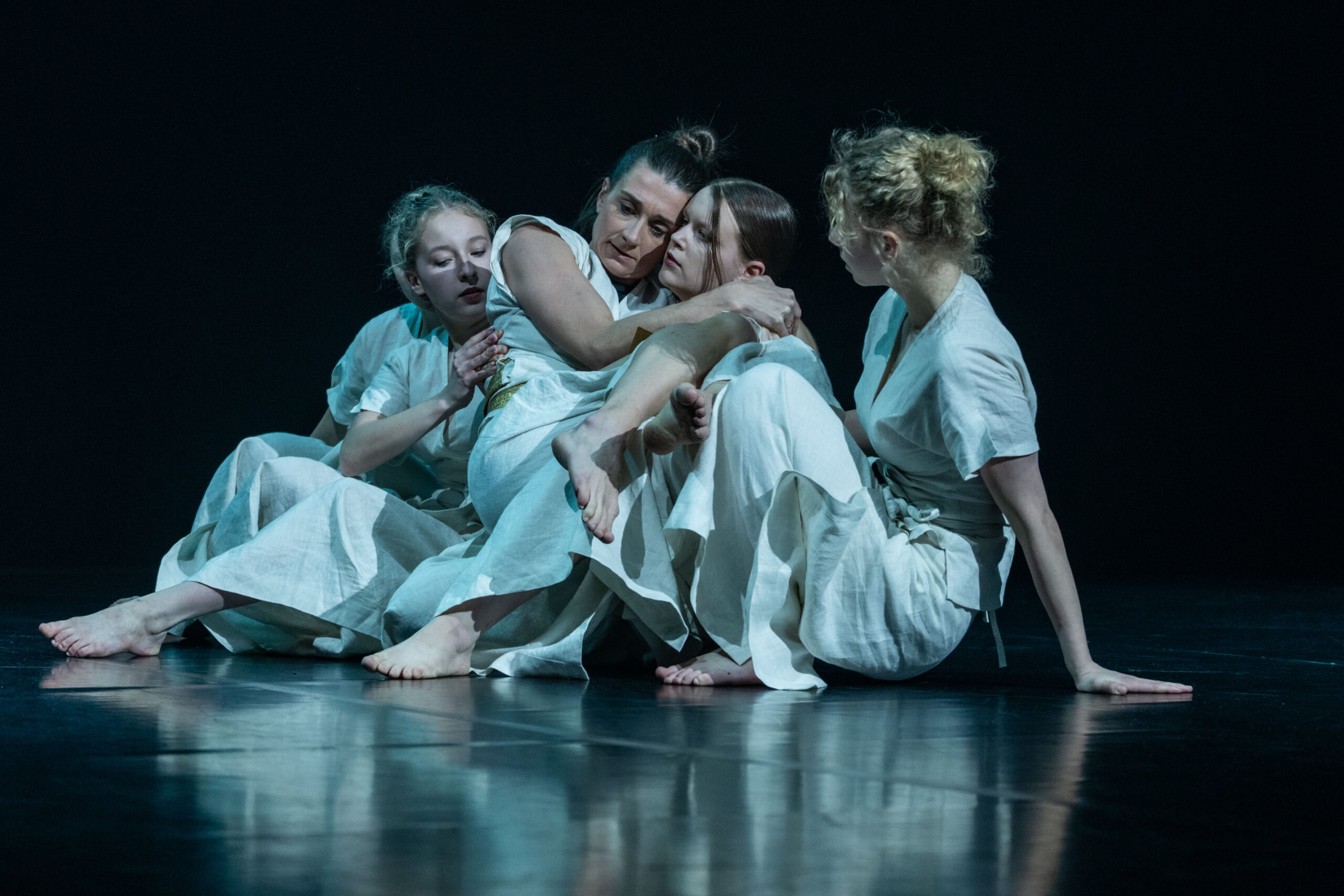
At the beginning of “Fragile Power” Lelde Feldmane addresses the audience directly, introducing herself and telling the story that inspired the performance. It is a story of Lelde and her mother caring for the grandmother, paralyzed after a stroke. The narrative carries on in the movement of Feldmane and four younger dancers (Leonilla Upeniece, Niola Ose, Beāte Ēķe, and Elizabete Ļaksa). The choreography is grounded in physical expressions of care and support, articulated through gestures of holding, carrying, catching during falls, and leaning on one another. The fact that Feldmane starts with positioning herself as a dancer, a circus artist, a daughter, a mother, and opening up, strengthens the personal character of the performance and invites the audience for a shared experience, while offering a key to decode and interpret what follows. This, in itself, could be seen as an act of caring – caring for the audience through making sure that the contexts would be clear and the performance understandable and accessible.
Thinking of performance as a social situation on a microscale, it is not possible to ignore the role of the audience, especially when a performance itself is defined as socially relevant. That is why I find it important to try to understand what changes once the audience’s presence is acknowledged, even if it is a subtle gesture lasting for a brief moment. The stage has so much more potential than just to be a place for illustrative storytelling. It can also become a space for curious and courageous exploration of movement, interaction, and presence, with the awareness that performance is a shared experience unfolding here and now.
*Ada Ruszkiewicz is a Polish theatre critic, researcher, producer, and curator of interdisciplinary projects. Since 2021, she has been living and working in Latvia.
1 The three other performances premiered in the last two years, and have been written about in separate reviews (available in Latvian):
“Ar acīm ciet” (premiere on 14.04.2025): https://dance.lv/lidz-kermenim-kas-izskist-gaisma-par-ar-acim-ciet/
“Savējā un svešā” (premiere on 14.03.2025): https://dance.lv/piederibas-kermeniskas-robezas-par-izradi-saveja-un-svesa/
“Es arī esmu Latvija” (premiere on 07.08.2024): https://dance.lv/dieviete-un-divi-geji-par-sixth-izrazu-vakaru-sometimes-i-do-something/