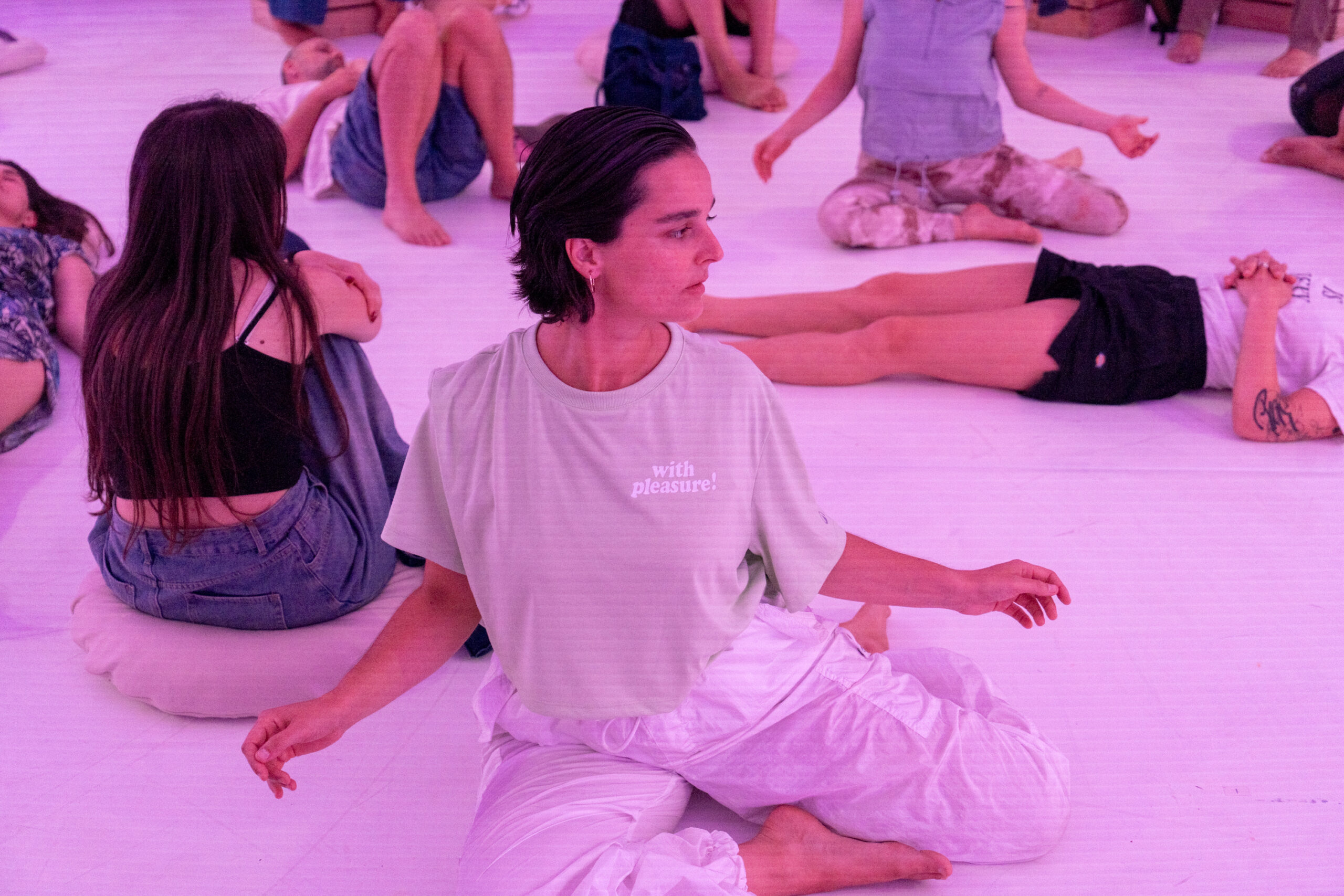
Flavia Zaganelli, Italian choreographer, brings her piece “Placebo Dances” to Riga on September 5 and 6 as part of the Homo Novus Festival. The performance took place at Creative Factory “Veldze”, where performers and audience shared the same space in close physical proximity. Before her visit, I asked her about pleasure, intimacy, and why feeling satisfied can also be a political act.
How it began
The work started in 2020, during Covid-19, a period that pushed her to reconsider how she wanted to work with her body altogether.
“It was clear to me that I was stuck with a certain kind of way of working with my body, pushing the limits, performative, demonstrative, and so on. I could not stand it anymore, both physically and theoretically. I needed to get back to working with my body through a different lens and perspective: doing what feels good to me.”
The shift in my work wasn’t about making movement easier. It was about listening differently to intuition, presence, and open senses. She returned to her own archive of exercises and dances, collecting the ones that made her feel most present in her body.
“My question, starting this research, was: are there any specific exercises that have the power to create a pleasant condition in my body? And do these practices work in the same way for other people and other bodies?”
She began testing this in workshops, moving between deep, intense meditation and almost trance-like states. What fascinated her was how differently people responded. This is where the idea of “placebo” entered the research.
“Is there a dance that can create a condition of pleasure in the body simply because one wants it to happen? The placebo effect is a sort of superpower our body possesses: the ability to create specific conditions simply by believing in them. Can dance have the same effect? The same capacity to create a condition of deep presence that can create vitality between our cells and make us feel good? I deeply believe it can.”
Pleasure in dark times
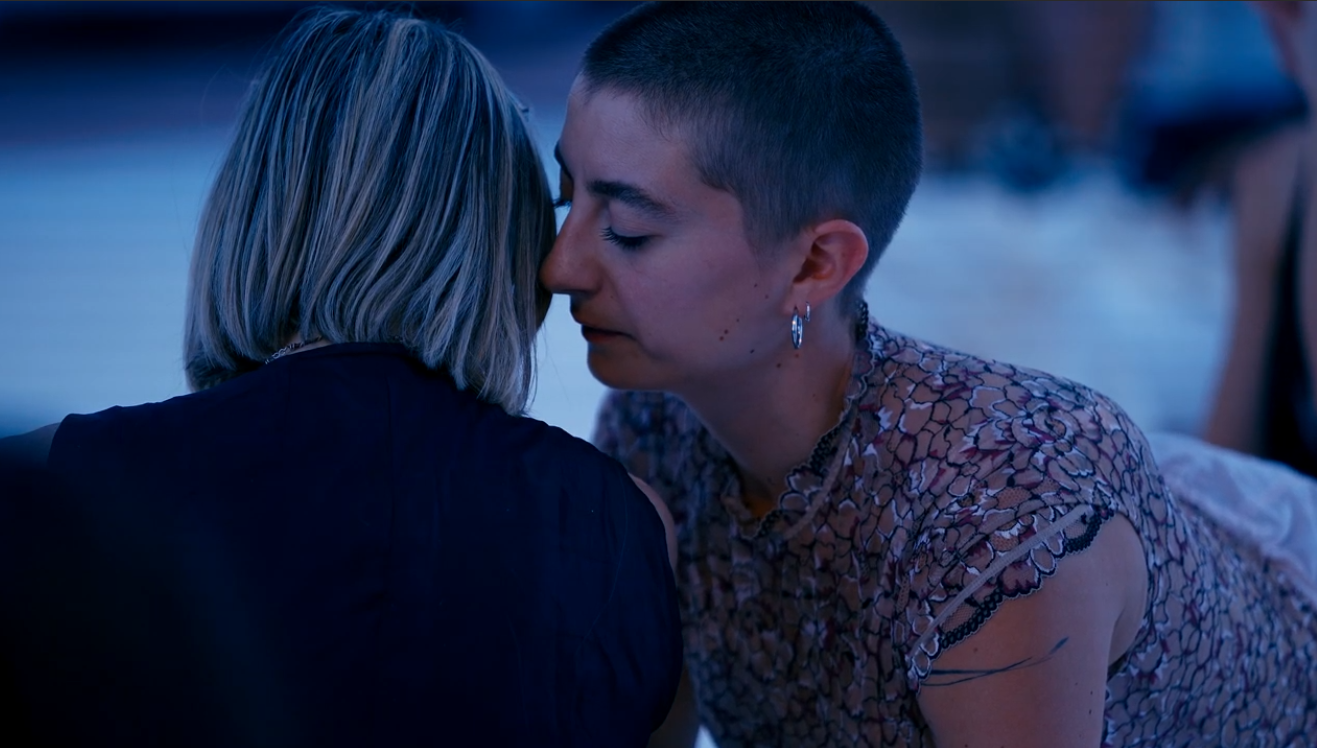
The performance is described with the phrase “pleasure as salvation in times of catastrophe”, a phrase that sounds almost contradictory. Why pleasure, especially now?
“I think pleasure is a condition that is very connected to a state of deep presence, connection and vitality. For me, something is pleasant when I am able to feel deeply with as many senses as I can achieve to open up. It is a condition of being very, very alive. I can find pleasure in simple, everyday things if I am present in what I am doing, if my senses are wide awake, if my capacity to connect with what I am doing, and with whom I am is present.”
Can something as personal as pleasure also be political?
For Zaganelli, the answer is clear. Her thinking is strongly influenced by queer and transfeminist perspectives, as well as writers such as Audre Lorde and Adrienne Maree Brown.
“Feeling good is personal, but it is very much collective as well. I think every personal act is deeply political, from the choices we make every day at the grocery store to how much effort we put into making our lives more pleasant for ourselves, our lovers, our community, but also for strangers. In this time of strong individualism and dark, harsh masculinity, sharing a joyful, lively, and pleasant activity [together] is very political and very needed.”
As a queer woman, she connects this directly to the right to sexual pleasure and its representation. Placebo Dances plays with sensuality, sexuality, the gaze and objectification, while remaining aware that the performers’ bodies carry meanings beyond their own intentions.
Close, but without touching
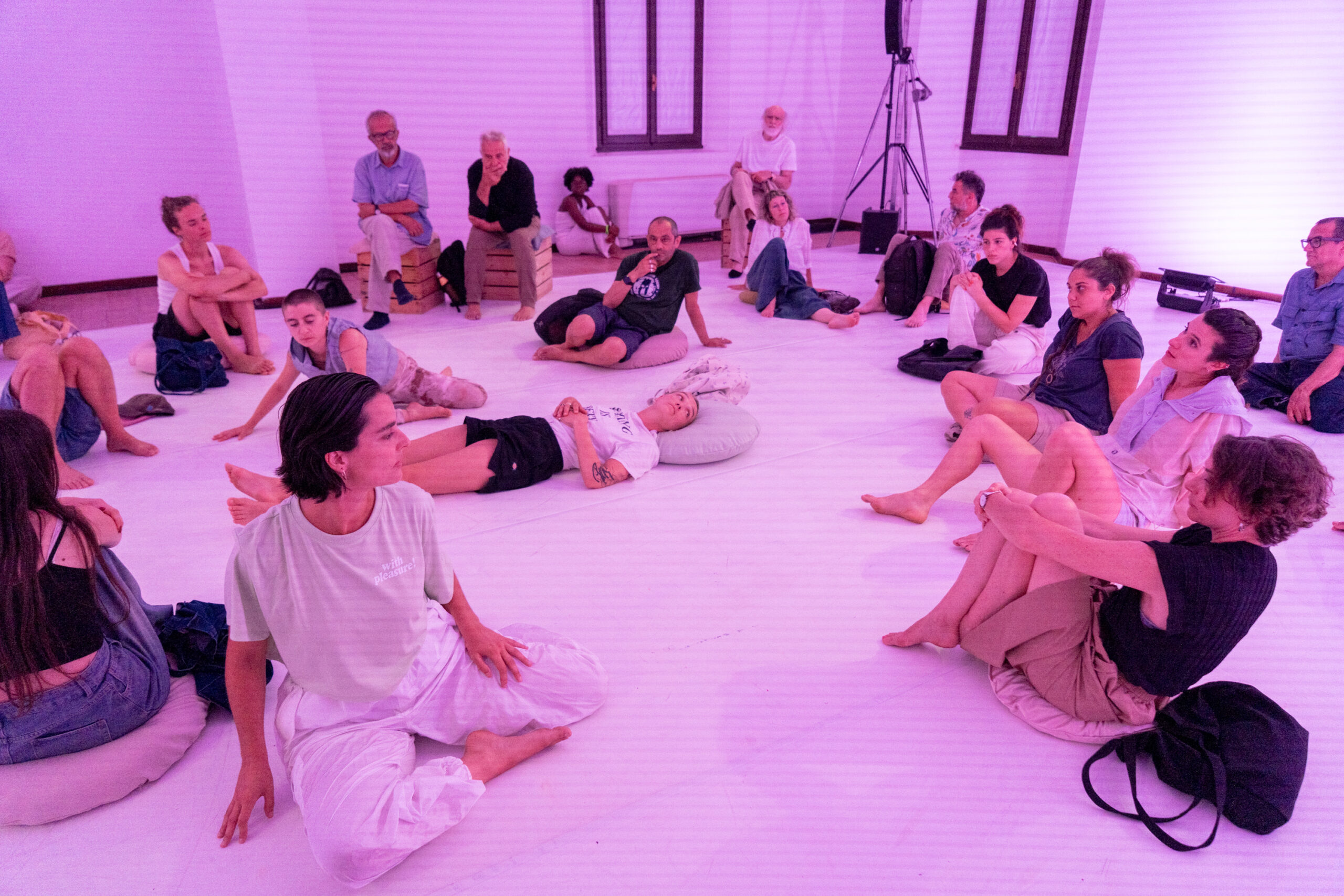
Direct touch is almost absent between performers and audiences. So how do you build intimacy without it?
“At this moment, I am not interested in creating conventional stage work. I am not interested in distance, in the high and low, in the kind of sacredness of the stage and the dancer. I am instead interested in the mixture, in the shared experience, in the proximity of bodies and minds.”
Audiences are free to keep their eyes open or closed, to lie down or stay alert, but that freedom does not mean the experience always stays comfortable.
“In these kinds of performances, comfort and discomfort go together. It is undeniable. Discomfort is there, and it is something I am very interested in too. It is not good or bad in itself. I think it is a part of every human condition, even a pleasant one. We hope this work is capable of touching people profoundly but without the need for skin-to-skin contact. We are interested in the space in between us, where the magic of dance actually happens.”
Relationships of people, bodies, nature and technology appear throughout much of Zaganelli’s work. When I asked what keeps bringing her back to this theme, her answer was simple:
“I still don’t know why. But this is probably the way I see the world: as a dance of objects in connection with each other.”
Years into this research, her own understanding of pleasure has shifted too.
“I think pleasure [for me] is very much connected to a condition of deep presence, of opening the senses, of abandonment, of attunement, of feeling alive, of having a sensual, erotic experience of something, and not at all only and strictly connected to sex.”
After all the larger questions around pleasure, politics and the body, I wanted to ask something much simpler: what is one everyday thing that gives her pleasure?
“Ah, this is the hardest question to answer lightly. As I said, [for me] it is less about the what and more about the how, but of course, listening to a very good song can be an excellent way to feel deeply.”
And what does she hope stays with the audience after “Placebo Dances”?
“Not necessarily an idea, but maybe a feeling or a sensation. A possibility of tenderness that could stay with them.”
Questions prepared and article written by Sabine Neilande.
More about the artist: flaviazaganelli.com
Cover photo: Flavia Zaganelli in “Placebo deances”. Photo: Pietro Bertora